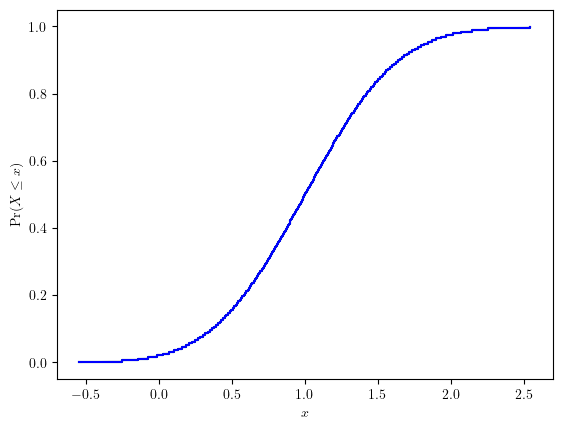
Characterise the uncertainty given what you know
It is vital to know what you do not know in terms of trustworthy modelling and predictions, suggesting that all models are wrong but some are useful on the condition of knowing their assumptions and applicability, hence building the credibility of the computational results. It is often a challenge, in modelling complex physical phenomena, to construct mathematical models in a quantitative manner, on one hand, without ignoring significant information and, on the other hand, without introducing unwarranted assumptions. The bottleneck is usually the limited information in terms of both knowledge and experimental data.
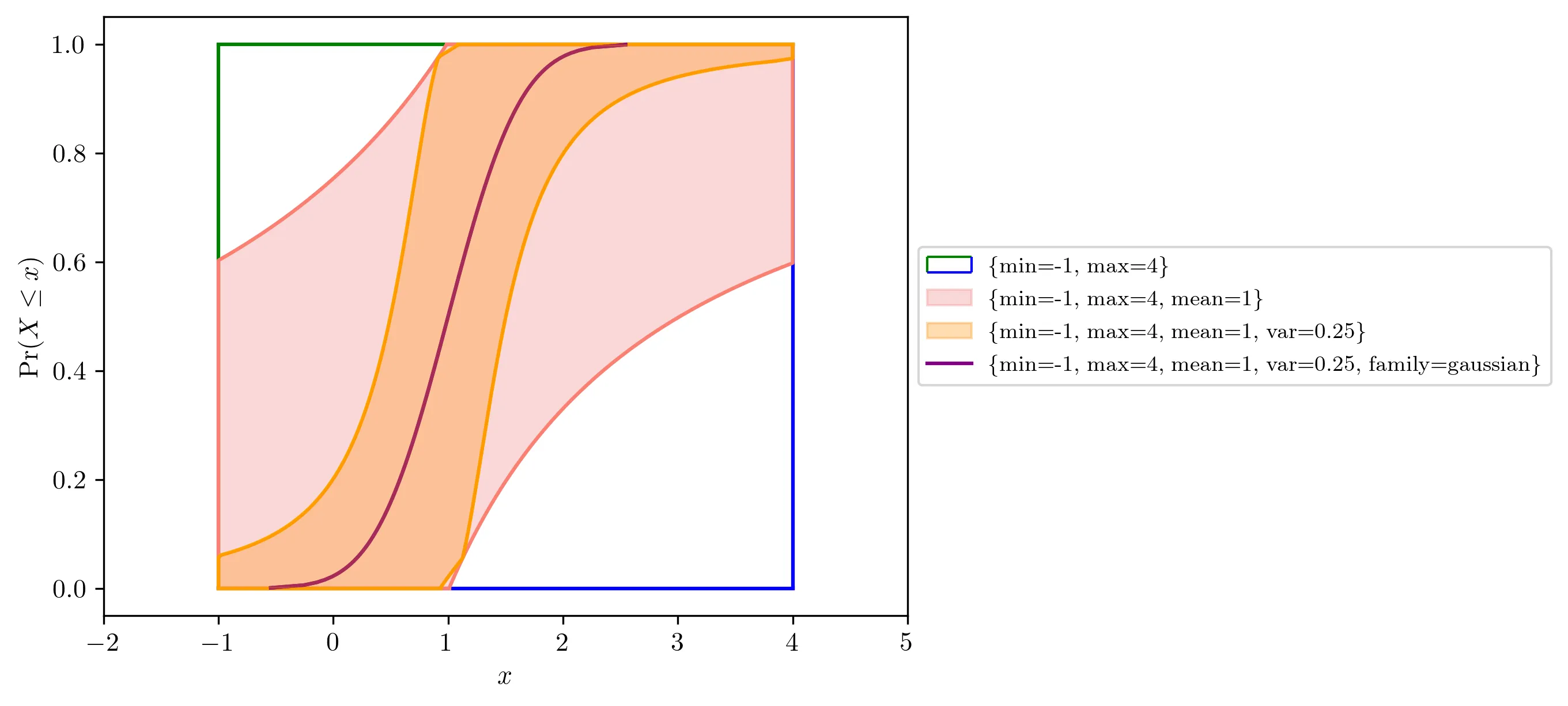
Often there is little empirical information pertaining some parameters of a mathematical model. A faithful characterisation entails that all of the available statistical information should be utilised but without introducing any extra assumptions beyond what are empirically justified.
The bounding approach presents as a natural reflection of the state of epistemic uncertainty, which tightens the bounds with extra empirical information.
Conveniently, pyuncertainnumber provides a bespoke constructor to facilitate the faithful characterisation of uncertain quantities based on known information, which includes limits on quantiles, information about summary statistics such as mean, mode or variance, and qualitative information about distribution shape, such as whether it is symmetric or unimodal.
import pyuncertainnumber as pun
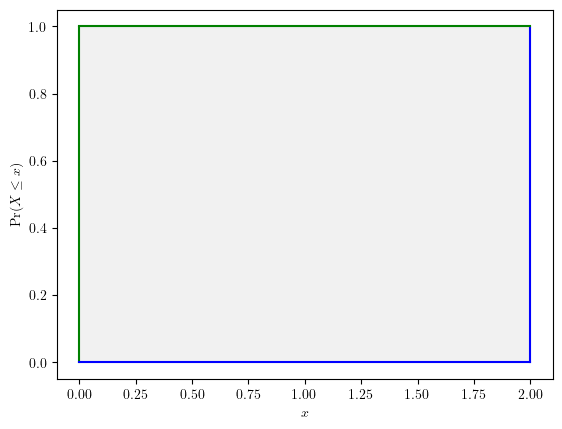
For example, the level of information specifies constraints to accordingly construct the uncertain number, which may start as little as a coarse estimated range
# specify available empirical information as constraints
pun.known_properties(minimum=-1, maximum=4).display()
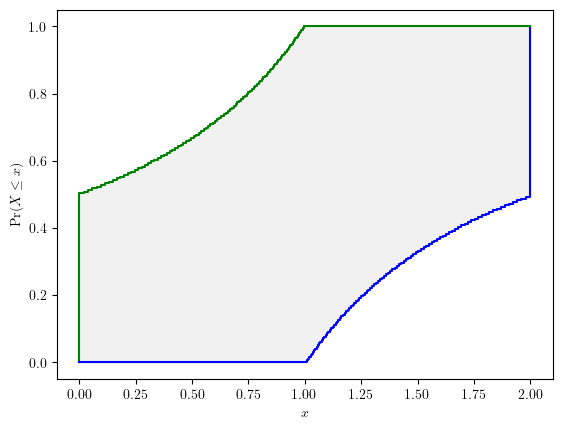
further one may have statistical moment information, for example the mean value from domain experts
pun.known_properties(minimum=-1, maximum=4., mean=1).display()
beyond the central tendency(i.e. mean), one may also have the variability information
pun.known_properties(minimum=-1, maximum=4., mean=1, var=0.25).display()
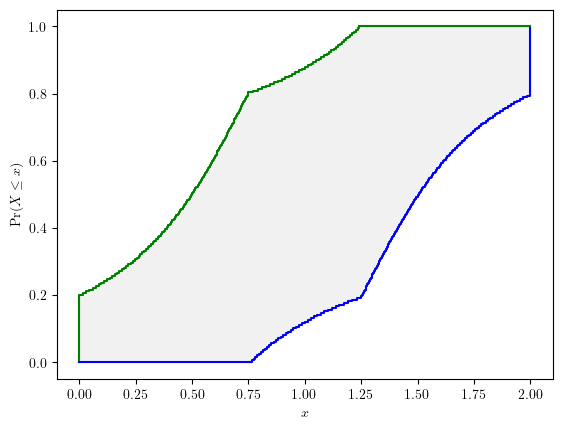
Further, expert eclicitation may have strong beliefs as to the knowledge of shape such that uncertainties can be pinched to a precise distribution.
Tip
The empirical knowledge naturally serves as constraints to contract the bounds associated with an uncertain number. However, it should be noted that in some cases constraints may not converge, which suggests that the applied knoweledge may contradict with each other. For example, if an expert claims the distribution shape to be lognormal, this shape may not be consistent with the other information.
pun.known_constraints(minimum=-1, maximum=4., mean=1, var=0.25, family='gaussian').display()